Nearly one in two travellers (47%) uses metasearch to compare hotel prices online, according to data collected by ResearchNow between 2013 and 2015. Trivago, one of the world’s most popular metasearch websites, reported a 59% growth in users searching for hotel prices over the course of 2015. This growth has continued over the following year; in 2016, the company finally went public, with its ahres listed at $11 on NASDAQ.
Similarly, the UK-based Momondo Group has predicted that the global metasearch industry will produce more than a compound annual growth rate of more than 40% between 2014 and 2017; furthermore, US company Kayak is estimated to receive as many as 3.5 billion search queries by 2019.
Further afield, the co-founder of Singapore-based Wego, Ross Veitch, has highlighted the growth that travel metasearch has experienced in emerging markets. According to Veitch, ‘the travel meta model has proven that it’s a winner with consumers over many years in the developed world and that a very large, scalable, profitable businesses can be built from it. Qunar [a Chinese-language travel provider and mainland search engine] has proven that the model, albeit with a lot of after-market modifications, works just as well in the fast-growing emerging market.’
But how can hotels, and in particular smaller independents, capitalise on this growth?
The 2013 L2 report pointed out that metasearch engines provide hotel brands with an opportunity to fight back against the almighty Online Travel Agents (OTAs), by driving consumers to brand websites for direct bookings at higher margins. However, according to the same report, hotels are still ceding this important channel to OTAs.
WHAT is Metasearch?
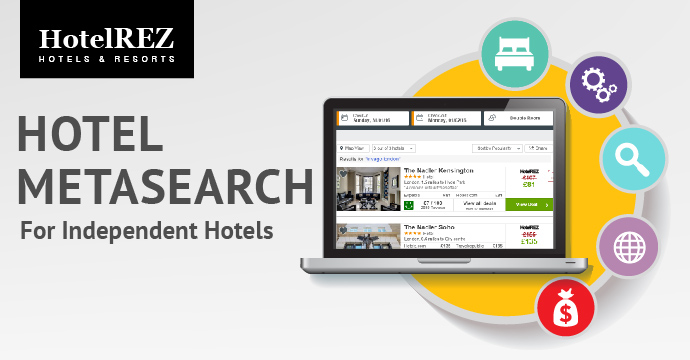
A metasearch website or engine is essentially an aggregator of rates and availability from multiple different sources. With such a tool, travellers are able to run a query for a specific location or hotel, within a set of dates, and rates and availability are returned from multiple different websites at the same time. The consumer is thus spared from having to compare the different rates from different providers.
WHO are the biggest players in hotel Metasearch?
With the launch of a hotel metasearch functionality in 2013, TripAdvisor shook up the meta space by being the first to match real-time pricing and availability, with more than 200 million reviews and opinions from its loyal users.
Other Players
- HotelsCombined
- Momondo
- Skyscanner
- Hipmunk
WHERE in the world are users/bookers coming from?
A significant number of travellers across the globe are using metasearch, with the Chinese leading the way, with as many as 54% of all travellers reportedly using metasearch for placing travel bookings.
- China – 54%
- France – 42%
- Germany – 38%
- United Kingdom – 36%
- USA – 35%
Market studies also report a larger proportion of millennials using metasearch for travel reservations, 39% according to an L2 report, a figure that trumps Generation X (25%), baby boomers (23%) and older generations (14%).
HOW can I get a piece of the action?
Most metasearch websites give you access to a set of analytics, so that you can keep an eye on your hotel campaigns’ performance, as well as a budget-capping functionality, securing full financial control.
WHY should I let a third-party manage my hotel campaigns?
Managing a cost-per-click (CPC) marketing campaign can be very hard work, particularly for independent hoteliers that lack the time or resources. That is why, at HotelREZ Hotels & Resorts, we have focused on providing a cost-effective metasearch service for independent hotels, which allows us to manage your campaigns easily, saving you both time and money.
Remember:
- CPC advertising requires expertise, as well as someone who is available to manage your bids on a daily basis.
- It is very easy to be out-bid by OTAs on the metasearch sites, as everyone is trying to get to the top positions.
- If a CPC campaign is poorly implemented, you can get a lot of clicks to your website, but these clicks may deliver relatively few reservations. Therefore, it is of the utmost importance to manage your metasearch strategy, budgets and bids very carefully, and regularly, so that your campaigns are optimized, and your marketing costs do not spiral out of control.
Want to know what HotelREZ can do for your Hotel?
HotelREZ Hotels & Resorts is a hotel representation company providing distribution, sales and marketing consultancy and technology to independent hotels and small chains. We provide properties with GDS representation under our own HO chain code, and help market hotels to thousands of travel and MICE agents and partners worldwide. For more information on joining our portfolio of unique and independent hotels contact our Business Development team today or complete our hotel membership enquiry form.